

Surgical Principles
The Nesbit procedure was first described in 1965, primarily involving the excision of an ellipse of tunica albuginea on the longer convex side, followed by suture closure using heavy non-absorbable sutures to correct penile curvature. Subsequent modifications include the Yachia procedure (longitudinal incising and transverse suturing). The modified Nesbit procedure (Hsu procedure) represents a refined approach within tunical shortening procedures, designed to straighten penile curvature with minimal invasiveness and high precision.
Anesthesia Method
Traditionally, penile curvature surgeries are performed under spinal (epidural) or general anesthesia.
Our clinic utilizes an advanced dual local anesthesia technique, comprising a dorsal penile nerve branch block and a peripenile crural block administered exclusively at the penile base. Patients remain fully conscious and comfortable throughout the procedure without systemic anesthesia risks, and are free to listen to music or use mobile devices during surgery.
Surgical Incision
A single subcoronal circumcising incision located discreetly beneath the coronal sulcus.
Hospitalization Required?
No hospitalization or overnight stay is required. The procedure is performed entirely on an outpatient basis, and patients can walk and return home comfortably after surgery.
Surgical Technique
With the patient in a comfortable supine position, precise dual local anesthesia is administered. Through a single subcoronal incision, microsurgical dissection is performed to gently separate tissue layers while meticulously preserving neurovascular bundles. Once the point of maximum curvature is identified and the tunica albuginea is fully exposed (with careful mobilization of the neurovascular bundle or urethra if indicated), an elliptical portion of the tunica albuginea on the longer convex side is excised (Figure 1-A, D & B, E). The tunical defect is then precisely approximated using ultra-fine sutures (Figure 1-C, F) to equalize bilateral corporal length and achieve complete straightening. If erectile dysfunction secondary to penile venous leakage is concurrently present, penile venous ligation can be performed simultaneously. The incision is closed in layers with fine absorbable sutures and dressed with light compression gauze.
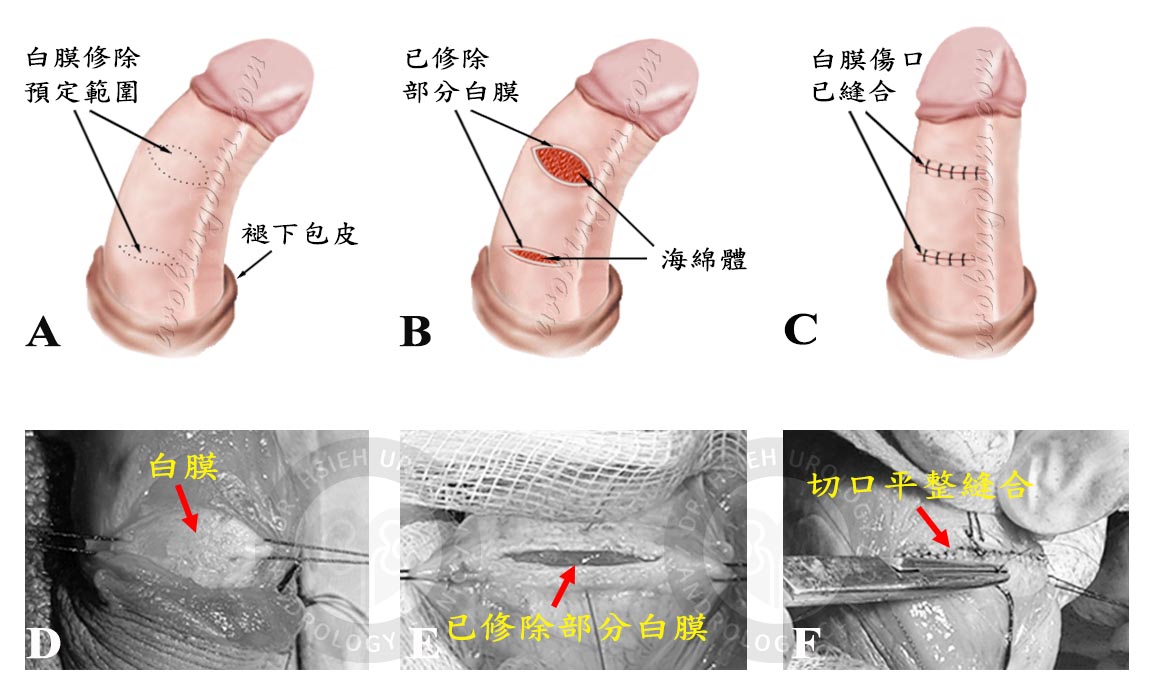
For severe curvature angles or complex anatomical deformities, tunica shortening may be combined with tunical grafting and lengthening to minimize loss of penile length. Hemostasis is achieved strictly with ultra-fine suture ligation rather than electrocautery, preventing thermal injury to adjacent erectile tissue, cavernous sinusoids, and sensory nerves.
Key Clinic Surgical Advantages
- Dual Local Anesthesia: Safe, precise local anesthesia avoiding the physiological risks and side effects of spinal or general anesthesia.
- Single Discreet Incision: Positioned in the coronal sulcus for minimal aesthetic impact and concealed scarring.
- Outpatient Day Procedure: Complete freedom to walk immediately post-surgery and return home without hospital stay.
- Ultra-Fine Sutures: Prevents palpable suture knots, granuloma formation, and persistent chronic tenderness associated with conventional heavy sutures.
- No Electrocautery: Zero thermal injury to erectile sinusoids, dorsal nerves, and terminal arteries, supporting rapid microvascular recovery and reduced infection risks.
- Microsurgical Precision: Based on comprehensive anatomical research into penile microarchitecture to maximize surgical safety and preserve erectile function.
Surgical Outcomes and Prognosis
Compared to tunical grafting, tunical shortening offers shorter operative duration, preserves natural erectile rigidity, and involves a less complex healing course. Compared to tunical plication, direct tunical excision and natural healing provide significantly lower long-term recurrence rates and avoid palpable subcutaneous lumps or indentations.
Conventional Nesbit procedures using thick non-absorbable sutures historically reported minor complications such as suture granulomas, local tenderness, or mild erectile stiffness changes in a minority of cases. In contrast, our modified microsurgical tunica shortening procedure utilizes delicate suture materials and fine anatomical dissection, resulting in outstanding cosmetic and functional satisfaction, minimal recurrence, and excellent preservation of erectile rigidity in long-term follow-up.
Clinical Summary
Modified tunica shortening surgery is ideal for men with adequate penile length and moderate penile curvature. Because only the convex side is adjusted, overall length reduction is modest and cosmetic alignment is excellent. For patients with high curvature angles or significant shortening concerns, combining tunica shortening with tunical grafting can be tailored. An individualized diagnostic evaluation by a specialized urologic surgeon is essential before selecting the optimal surgical plan.
Selected Publications
- Hsu GL, Molodysky E, Liu SP, Chang HC, Hsieh CH, Hsu CY. Reconstructive surgery for idealising penile shape and restoring erectile function in patients with penile dysmorphology and erectile dysfunction. Arab Journal of Urology. 11:375–383, 2013.
- Hsieh CH, Chen HS, Lee WY, Chen KL, Chang CH, Hsu GL. Salvage penile curvature correction surgery. Journal of Andrology. 31(5):450-456, 2010.
- Hsu GL, Hsieh CH, Wen HS, Hsieh JT, Chiang HS. Outpatient surgery for penile venous patch with the patient under local anesthesia. Journal of Andrology. 24(1):35-39, 2003.
- Hsu GL, Hsieh CH, Wen HS, Chen SC, Chen YC, Liu LJ, Mok MS, Wu CH. Outpatient penile implantation with the patient under a novel method of crural block. International Journal of Andrology. 27:147-151, 2004.
- Hsu GL, Hsieh CH, Chen HS, Ling PY, Wen HS, Liu LJ, Chen CW, Chua C. The advancement of pure local anesthesia for penile surgeries: can an outpatient basis be sustainable? Journal of Andrology. 28(1):200-205, 2007.
- Hsu GL, Hsieh CH, Chen SC. Human penile tunica albuginea: anatomy discovery, functional evidence and role in reconstructive and implant surgery. Global Advanced Research Journal of Medicine and Medical Science. 3(12):400-407, 2014.
Clinical article authored and revised by Dr. Cheng-Hsing Hsieh.