How Does It Work?
During physiological erection, blood flows through the penile arteries into two chambers known as the corpora cavernosa, which expand and harden the penis. These chambers are enveloped by a tough and elastic fibrous layer called the tunica albuginea. This structure also compresses the veins that would otherwise drain blood away, helping to maintain the erection.
For patients with medically refractory erectile dysfunction (ED) of any etiology, penile prosthesis implantation serves as a definitive and highly effective treatment option. The procedure involves inserting artificial penile cylinders into the corpora cavernosa to replace the natural erectile tissue. These cylinders remain safely concealed within the tunica albuginea, providing sufficient rigidity for normal sexual intercourse while maintaining a natural appearance and tactile sensation.
Anesthesia Options
Traditional Methods: Historically, this procedure has been performed under spinal or general anesthesia.
Advanced Dual Local Anesthesia: Our institution employs an innovative dual local anesthesia alone technique, comprising:
- penile dorsal nerve block
- penile crural block
- peri-penile infiltration block
Local anesthetic is injected solely at the base of the penis (Figure 1). Patients remain fully awake and pain-free during the operation, allowing them to comfortably use smartphones or Bluetooth devices.
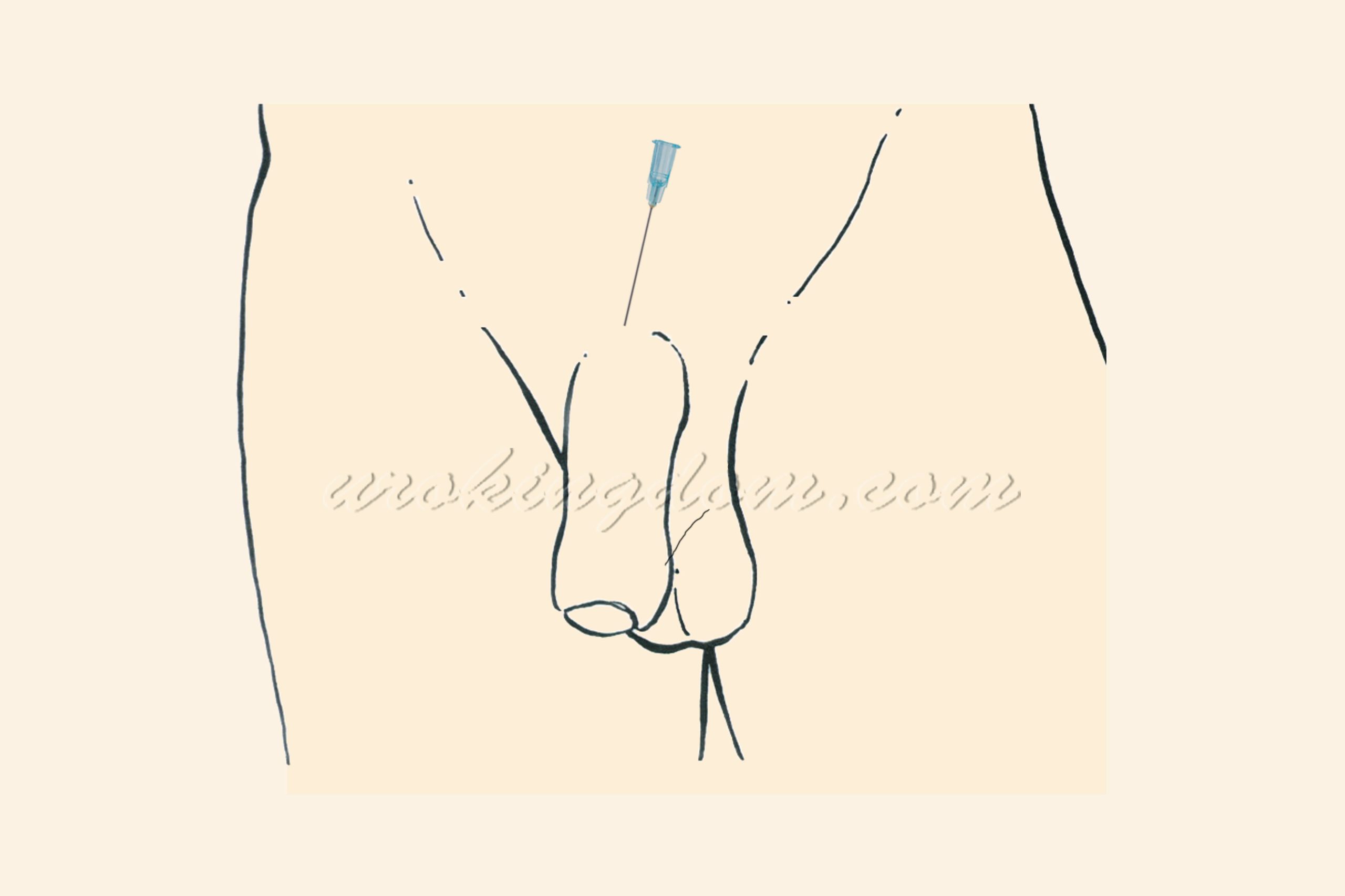
Figure 1: Dual local anesthesia alone: penile dorsal nerve block, crural block, and peri-penile infiltration block, with anesthetic administered exclusively at the penile base.
Surgical Incisions
Surgical access is typically achieved via:
- a subcoronal incision (similar to a circumcision) or
- a single incision located at the penoscrotal junction
- +/- an incision located at the pubic region
Hospital Stay
No overnight hospitalization is required. This is an outpatient procedure. Patients do not require extended postoperative observation and can ambulate freely and return home to rest on the same day.
Surgical Procedure Overview
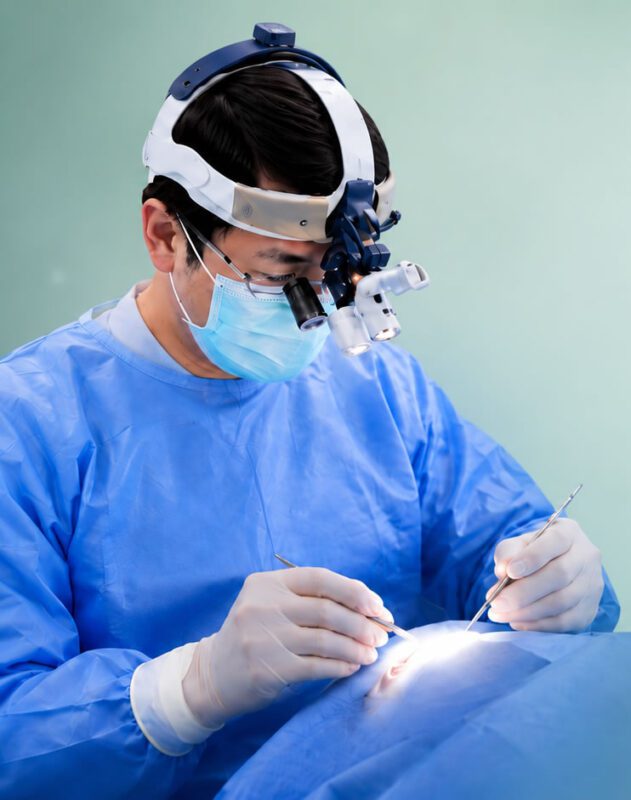
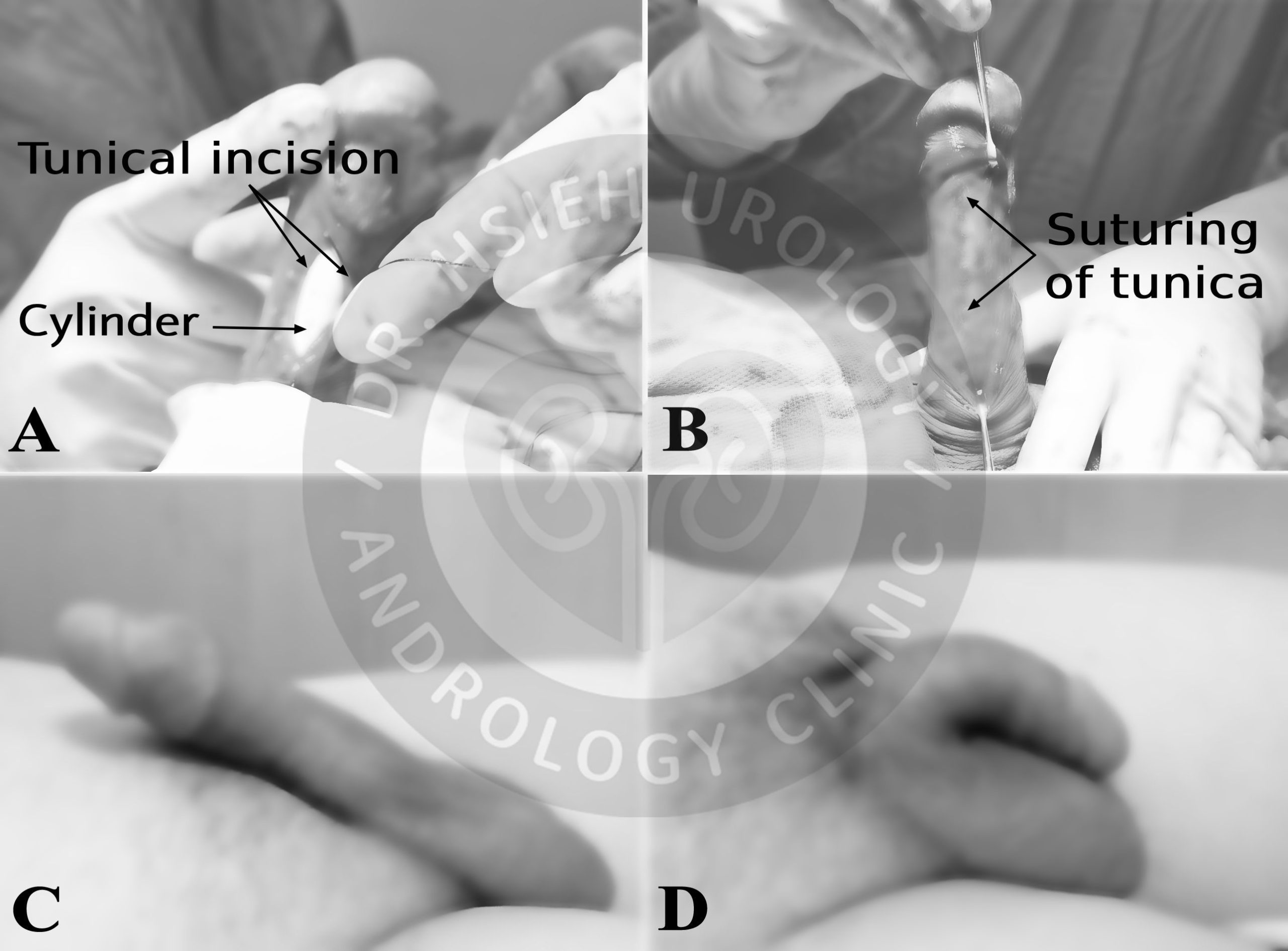
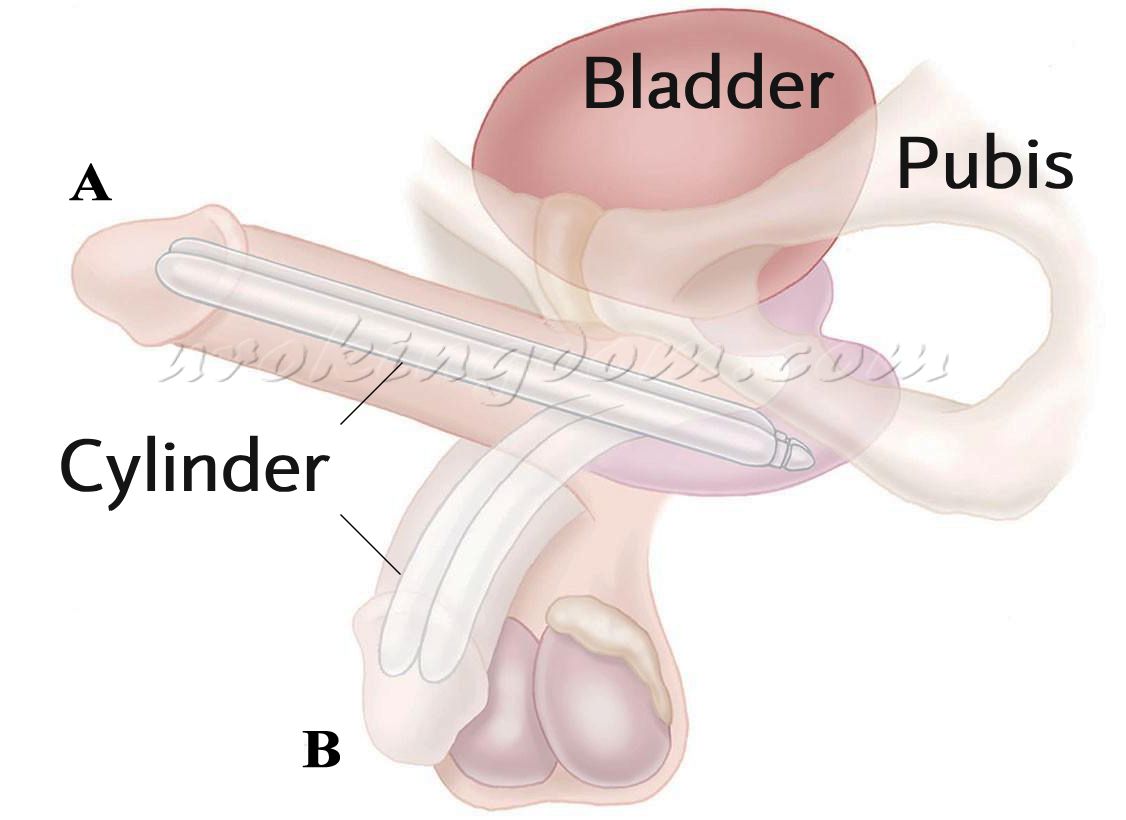
The surgery is performed with the patient in a supine position. Surgical incision is made to access the anatomy of penis. Employing meticulous microsurgical techniques, the underlying tissues are dissected to preserve adjacent nerves and blood vessels. The tunica albuginea is carefully separated from surrounding structures and incised bilaterally. Cylinders of the appropriate length are then implanted into the corpora cavernosa (Figure 2A), and the tunical incisions are closed with fine sutures (Figure 2B).
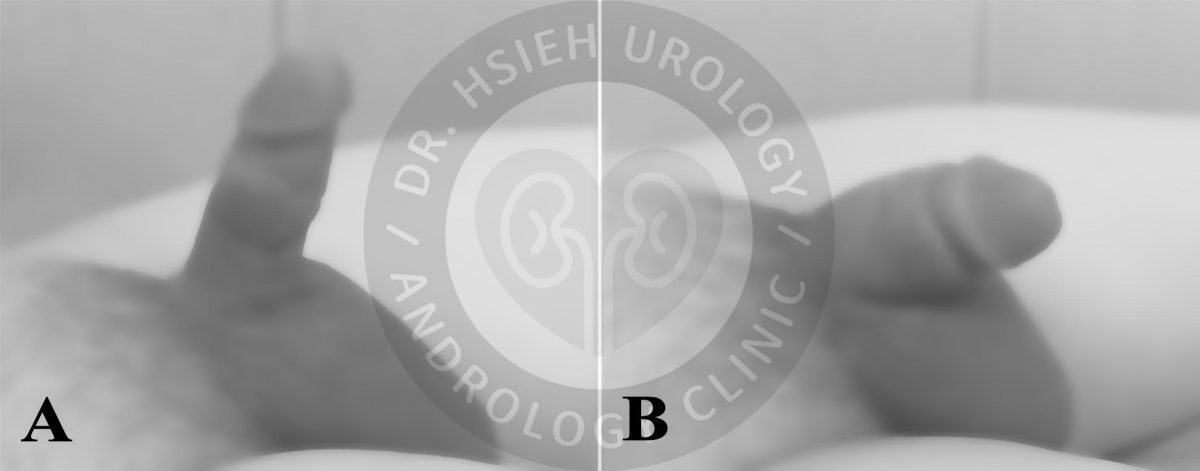
- Malleable (Semi-Rigid) Prosthesis: Once the cylinders are implanted, the wound is closed in layers with fine sutures and immediately dressed with a compressive gauze wrap. After a recovery period of approximately two months, the implant can be manually positioned upward for immediate sexual intercourse (Figure 2C) or bent downward for concealment (Figure 2D), as illustrated in Figure 3.
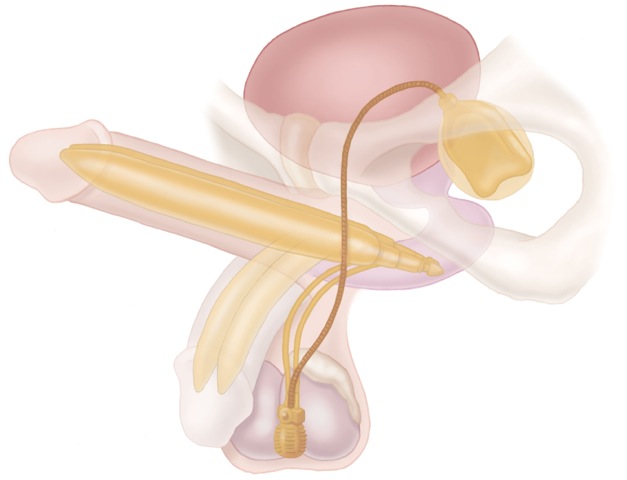
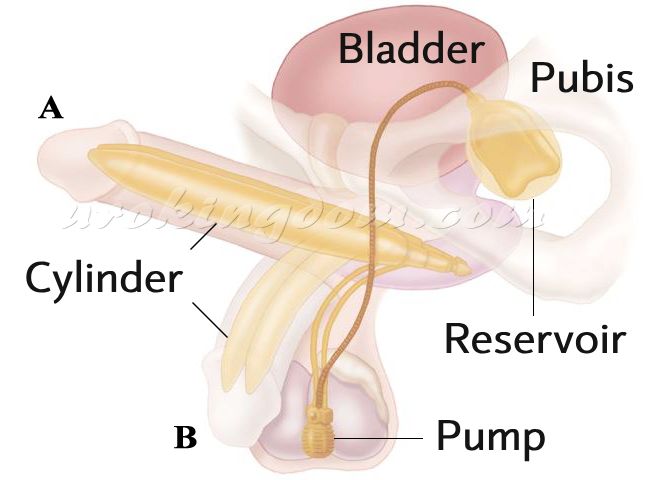
- Inflatable Penile Prosthesis (Three-Piece IPP): In addition to the cylinders, a discrete fluid pump is placed within the scrotum, and a fluid reservoir is positioned in the retropubic (prevesical) space (Figure 4). These three components are connected via internal silicone tubing. Following layer-by-layer wound closure and sterile dressing, the recovery period begins. Once healed, the patient compresses the scrotal pump to transfer fluid into the cylinders, achieving a firm erection for intercourse; pressing a dedicated release valve on the pump deflates the cylinders, returning the penis to a flaccid state (Figure 5).
- Hemostasis Protocol: This refined surgical technique involves minimal blood loss. If minor bleeding occurs, fine suture ligation is utilized instead of electrocautery. This avoids thermal collateral damage to surrounding tissues, arteries, and nerves, thereby minimizing postoperative complications.
If indicated, a concurrent circumcision can be performed to optimize local hygiene and mitigate postoperative preputial edema.
Why Choose Our Institution?
- Dual Local Anesthesia Alone: Eliminates the risks associated with general or spinal anesthesia.
- Single Minimally Invasive Incision: Optimizes cosmetic outcomes.
- Ambulatory Care: Walk-in, walk-out procedure with no hospital stay.
- Cautery-Free Hemostasis: By avoiding electrocautery, we mitigate thermal injury to adjacent neurovascular structures, preventing postoperative neuropathy, numbness, chronic pain, or ischemia-induced tissue necrosis. Clinical literature suggests that avoiding cautery preserves local microcirculation, enhances bacterial resistance, reduces infection rates, and promotes optimal wound healing.
- Microsurgical Precision: An in-depth understanding of penile anatomy guides our microsurgical approach, maximizing safety and minimizing complications.
This rigorous standard is applied across all our urological procedures as followings, resulting in highly safe surgeries with exceedingly low complication rates.
- Microsurgical circumcision
- Microsurgical No-Scalpel Vasectomy
- Microsurgical Hernia repair
- Microsurgical Varicocelectomy
- Penile curvature correction surgery
- Refined Penile venous stripping surgery
- Penile dorsal nerve block surgery
- Testicular prosthesis implantation
Clinical Prognosis & Outcomes
Because penile prosthesis implantation is reserved for patients with severe ED, systematic reviews indicate that overall patient and partner satisfaction rates generally exceed 85%, accompanied by significant improvements in the quality of sexual life.
- Surgical Risks and Potential complications: Documented potential complications include wound pain, edema, hemorrhage, hematoma, and delayed healing. Postoperatively, patients may experience subjective penile shortening, reduced engorgement of the glans, morphological changes, or a foreign-body sensation.
- Long-Term Considerations: Mechanical attrition may occur over time (e.g., fluid reservoir leaks or pump malfunction). Poor tissue healing or chronic pressure can occasionally lead to device erosion or extrusion. In rare instances of severe corporal infection, complete explantation of the device may be necessitated.
- Diabetic Management: For diabetic patients, strict glycemic control (HbA1c < 8%) is paramount to mitigating postoperative infection risks.
- Device Durability: A 2007 longitudinal study by Wilson et al. tracking 2,384 first-time IPP recipients reported mechanical survival (failure-free) rates of 90.0% at 1 year and 79.1% at 5 years. Device survival naturally decreased over time, resting at 68.5% at 10 years and 59.7% at 15 years.
Final Thoughts
Penile prosthesis implantation is the definitive, end-stage therapy for erectile dysfunction. While artificial devices inherently possess physical volume and cannot entirely replicate the physiological properties of a natural erection, they remain a highly reliable option for restoring sexual function and preserving orgasmic and ejaculatory capabilities.
The inflatable penile prosthesis requires a longer and more technically complex surgical procedure. Conversely, the malleable penile prosthesis offers shorter operative time and simpler surgical technique. As a result, the malleable option is frequently the preferred choice for frail patients, as well as in complex salvage or infected cases.
• Malleable ( Semi-rigid) Penile Prosthesis: Features a simpler structure and higher durability, but has a slightly unnatural subjective feeling, which usually requires only a short period of adaptation.
• Inflatable Penile Prosthesis: Offers better functional outcomes, but has a more complex structure and a higher risk of mechanical failure.•
All surgical interventions carry inherent risks. However, by employing meticulous microsurgical techniques and relying on precise anatomical expertise, our institution optimizes surgical safety and reduces the incidence of complications to an absolute minimum.
| Implant Type | Surgical Profile | Advantages & Limitations |
| Malleable (Semi-Rigid) Prosthesis | Shorter operative time; straightforward surgical technique. | Advantages: Simple, highly durable mechanism. Ideal for frail patients, or complex salvage/reconstruction cases. Limitations: May feel subjectively less natural initially, though most patients adapt quickly. |
| Inflatable Prosthesis (IPP) | Longer operative time; higher technical complexity. | Advantages: Superior functional and cosmetic results. Limitations: Complex mechanism carries a higher risk of mechanical failure. |
Footnotes: Resources
- Figure 3:https://www.bostonscientific.com/en-US/products/penile-prosthesis/spectra-concealable-penile-prosthesis/features–benefits.html
- Figure 5:https://www.bostonscientific.com/content/dam/bostonscientific/uro-wh/general/ams/hcp-resource-center-update/AMS-700-with-InhibiZone.jpg
Journal Publications
- Hsu GL, Hsieh CH (謝政興), Wen HS, Chen SC, Chen YC, Liu LJ, Mok MS, Wu CH. Outpatient penile implantation with the patient under a novel method of crural block (以新的陰莖腳局部麻醉方法施行陰莖植入門診手術). International Journal of Andrology. 27:147-151, 2004.
- Hsu GL, Hsieh CH (謝政興), Chen HS, Ling PY, Wen HS, Liu LJ, Chen CW, Chua C. The advancement of pure local anesthesia for penile surgeries: can an outpatient basis be sustainable (純粹局部麻醉施行陰莖手術的新進展)? Journal of Andrology. 28(1):200-205, 2007.
- Hsu GL, Zaid UX, Hsieh CH (謝政興), Huang SJ. Acupuncture assisted local anesthesia for penile surgeries (針灸輔助局部麻醉下施行陰莖手術). Translational Andrology and Urology. 2(4):291-300, 2013.
- Hsu GL, Hsieh CH (謝政興), Wen HS, Hsu WL, Chen YC, Chen RM, Chen SC, Hsieh JT. The effect of electrocoagulation on the sinusoids in the human penis (電燒止血對於人類陰莖海綿體的影響). Journal of Andrology. 25(6):954-959, 2004.
- Hsu GL, Hsieh CH (謝政興), Wen HS, Hsu WL, Wu CH, Fong TH, Chen SC, Tseng GF. Anatomy of the human penis: the relationship of the architecture between skeletal and smooth muscles (人類陰莖解剖構造:骨骼肌和平滑肌之間的結構關係). Journal of Andrology. 25:426-431, 2004.
- Hsieh CH (謝政興), Liu SP, Hsu GL, Chen HS, Molodysky E, Chen YH, Yu HJ. Advances in understanding of mammalian penile evolution, human penile anatomy and human erection physiology: Clinical implications for physicians and surgeons (了解哺乳類動物的陰莖進化、人類陰莖解剖學和人類勃起生理學方面的進展:對於內外科醫生的臨床意涵). Medical Science Monitor. 18(7): RA118-125, 2012.
- Hsu GL, Hsieh CH (謝政興), Chen SC. Human penile tunica albuginea: anatomy discovery, functional evidence and role in reconstructive and implant surgery (人類陰莖白膜:解剖學發現、功能上證據和在重建及人工陰莖植入手術中的角色). Global Advanced Research Journal of Medicine and Medical Science. (GARJMMS) 3(12):400-407, 2014.
- Hsu GL, Hsieh CH (謝政興), Wen HS, Chen YC, Chen SC, Mok MS. Penile venous anatomy: an additional description and its clinical implication (陰莖靜脈解剖構造:附加描述及其臨床意涵). Journal of Andrology. 24(6):921-927, 2003.
- Hsu GL, Wen HS, Hsieh CH (謝政興), Liu LJ, Chen YC. Traumatic glans deformity: reconstruction of distal ligamentous structure (外傷性龜頭畸形:重建遠端韌帶結構). Journal of Urology. 166:1390, 2001.
- Hsu GL, Lin CW, Hsieh CH (謝政興), Hsieh JT, Chen SC, Kuo TF, Ling PY, Huang HM, Wang CJ, Tseng GF. Distal ligament in human glans: a comparative study of penile architecture (人類龜頭遠端韌帶:一項比較研究陰莖結構). Journal of Andrology. 26(5):624-28, 2005.
- Hsu GL, Hill JW, Hsieh CH (謝政興), Liu SP, Hsu C. Venous ligation: a novel strategy for glans enhancement in penile prosthesis implantation (靜脈綁紮手術: 人工陰莖植入手術時增大龜頭的新方法), in Genitourethral Reconstruction, Ralf Herwig R, Sansalone S, Rehder P, Editors. BioMed Research International. Published special issue, Article ID923171, 7 pages, 2014.
- Hsieh CH (謝政興), Hsu GL, Chang SJ, Yang SSD, Liu SP, Hsieh JT. Surgical niche for the treatment of erectile dysfunction (手術治療勃起功能障礙的利基). International Journal of Urology. 27(2):117-133, 2020.
Book Chapters
- Cheng-Hsing Hsieh (謝政興)、Geng-Long Hsu (許耕榕). 治療勃起功能障礙 – 手術治療(Erectile Dysfunction – Surgical Management).書名:男性性功能障礙 – 臨床診治全攻略 (Male Sexual Dysfunction – A Complete Guide to Diagnosis and Treatment), 陳煜、簡邦平、蔡維恭、陳卷書編輯. 合記圖書出版社, 2023. 第三篇,第17章,頁245-262.
- Cheng-Hsing Hsieh (謝政興)、Geng-Long Hsu (許耕榕). 勃起功能障礙 – 手術治療 (Erectile Dysfunction – Surgical Treatment). 書名:臨床泌尿學 (CLINICAL UROLOGY). 郭漢崇、賴明坤、楊啟瑞、黃一勝、余燦榮、陳進典、崔克宏,編輯. 台灣泌尿科醫學會, 2012.第八篇,第54章,頁1037-1049.
- Geng-Long Hsu (許耕榕)、Cheng-Hsing Hsieh (謝政興). 書名:A LABORATORY MANUAL FOR POTENCY MICROSURGERY (性功能顯微手術實驗訓練手冊). 許耕榕、謝政興,編輯.
References
- Goodwin WE, Scott WW. Phalloplasty. J Urol. 1952; 68: 903.
- Beheri GE. Surgical treatment of impotence. Plast Reconstr Surg. 1966; 38: 92.
- Pearman RO. Insertion of a silastic penile prosthesis for the treatment of organic sexual impotence. J Urol. 1972; 107: 802-806.
- Small MP, Carrion HM, Gordon JA. Small-Carrion penile prosthesis: new implant for management of impotence. Urology 1975; 5: 479.
- Finney RP. New hinged silicone penile implant. J Urol 1977; 118: 585-587.
- Jonas U, Jacobi GH. Silicone-silver penile prosthesis: description, operative approach and results. J Urol. 1980; 123: 865-867.
- Scott FB, Bradley WE, Timm GW. Management of erectile impotence: use of implantable inflatable prosthesis. Urology. 1973; 2: 80-82.
- Furlow WL. Inflatable penile prosthesis: Mayo clinic experience with 175 patients. Urology. 1979; 13: 166-171.
- Montague DK. Experience with semirigid rod and inflatable penile prostheses. J Urol. 1983; 129: 967-968.
- Burnett AL, Nehra A, Breau RH, et al. Erectile Dysfunction: AUA guideline. 2018;https://www.auanet.org/guidelines/non-oncology-guidelines/sexual-and-reproductive-health.
- Hellstrom WJG, Montague DK, Moncada I, et al. Implants, mechanical devices, and vascular surgery for erectile dysfunction. J Sex Med. 2010; 7:501-523.
- Wilson SK, Carson CC, Cleves MA, et al. Quantifying risk of penile prosthesis infection with elevated glycosylated hemoglobin. J Urol. 1998; 159:1537–1539. discussion 9–40.
- Chiang HS, Wu CC, Wen TC. 10 years experience with penile prosthesis implantation in Taiwanese patients. J Urol. 2000; 163: 476-480.
- Wilson SK, Delk JR, Salem EA, Cleves MA. Long-term survival of inflatable penile prostheses: single surgical group experience with 2384 first-time implants spanning two decades. J Sex Med. 2007; 4:1074-1079.
- Brant MD, Ludlow JK, Mulcahy JJ. The prosthesis salvage operation: immediate replacement of the infected penile prosthesis. J Urol. 1996; 155: 155-157.
- Mulcahy JJ. Treatment alternatives for the infected penile implant. Int J Impot Res. 2003; 15(Suppl 5): S147-149.
- Carson, C. C., & Mulcahy, J. J. (2019). Penile prostheses: Current recommendations. Urologic Clinics of North America, 46 (4), 541–553. https://doi.org/10.1016/j.ucl.2019.07.002
- Barton, G. J., Carlos, E. C., & Lentz, A. C. (2019). Sexual quality of life and satisfaction with penile prostheses. Sexual Medicine Reviews, 7(1), 178–188. https://doi.org/10.1016/j.sxmr.2018.10.003
- Mulcahy, J. J. (2000). Long-term experience with salvage of infected penile implants. The Journal of Urology, 163 (2), 481–482. https://doi.org/10.1016/S0022-5347(05)67910-2
- Henry, G. D., Wilson, S. K., Delk, J. R., et al. (2012). Revision washout decreases penile prosthesis infection in revision surgery: A multicenter study. The Journal of Urology, 188 (4), 126–131.
- Montague, D. K., Angermeier, K. W., & Lakin, M. M. (2001). Penile prosthesis implantation. Urologic Clinics of North America, 28 (2), 355–361.
- Eid, J. F., Wilson, S. K., Cleves, M., & Salem, E. A. (2012). Coated implants and infection reduction. The Journal of Urology, 188 (2), 504–508.
- Salonia, A., Bettocchi, C., Boeri, L., et al. (2023). European Association of Urology guidelines on sexual and reproductive health. European Urology, 84 (1), 1–54.
- Wilson, S. K., & Delk, J. R. (1995). Inflatable penile implant infection: Predisposing factors and treatment suggestions. The Journal of Urology, 153 (3), 659–661.