

Surgical Principles
While the Nesbit procedure and tunical plication are tunical shortening techniques that straighten penile curvature by shortening the longer convex side, tunica albuginea grafting and lengthening surgery adopts an alternative reconstructive philosophy: grafting tissue onto the shorter concave side to elongate it. This approach significantly preserves erect penile length, overcoming the length-loss limitation of conventional shortening techniques.
Anesthesia Method
Penile reconstruction of this complexity has traditionally been performed under general or spinal anesthesia.
Our clinic performs this procedure under advanced dual local anesthesia, consisting of a dorsal penile nerve branch block and a peripenile crural block injected solely at the base of the penis. The patient remains completely conscious and pain-free throughout the operation without the physiological stresses or side effects of general anesthesia, and can comfortably listen to music or use a mobile device.
Surgical Incision
A single subcoronal circumcising incision located beneath the coronal sulcus (if necessary, a small additional longitudinal incision of approximately 3 cm may be placed at the penile base).
Hospitalization Required?
No hospitalization or overnight stay is needed. The surgery is performed entirely as an outpatient procedure, and patients can comfortably walk home immediately afterward.
Surgical Technique
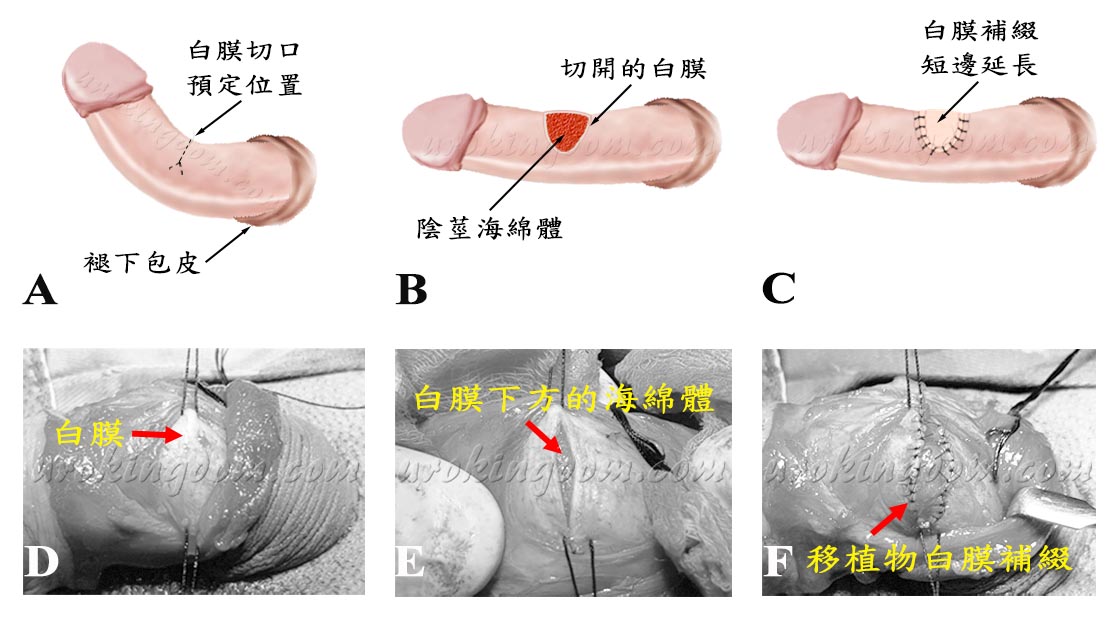
For patients with curvature exceeding 60 degrees or severe penile indentation, tunica grafting and lengthening is often indicated. Under precise dual local anesthesia, a subcoronal circumcising incision is made and the penile skin is mobilized. Using meticulous microsurgical dissection, tissues are mobilized while carefully preserving sensitive dorsal nerves and deep vessels. The maximum point of curvature is identified, and the tunica albuginea is separated from surrounding tissues (mobilizing the neurovascular bundle or urethra if necessary, Figure 1-A, D). A transverse incision is created across the shorter concave tunica albuginea; any underlying calcified Peyronie’s plaques are excised or incised (Figure 1-B, E). A patch graft is then precisely sutured into the tunical defect using ultra-fine sutures (Figure 1-C, F) to elongate the short side and match the length of the opposite side, achieving complete straightening. Finally, the skin incision is closed in layers with fine absorbable sutures and dressed with a compression bandage.
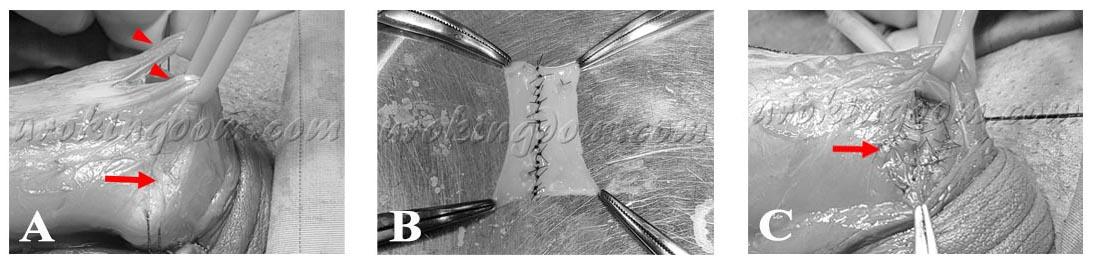
In cases of dorsal curvature, neurovascular bundle mobilization (Figure 2-A) is carefully performed. An autologous venous graft is obtained (Figure 2-B) and sutured into the tunical defect (Figure 2-C). For complex multidirectional deformities, tunica grafting may be combined with a modified tunica shortening procedure to achieve optimal geometric straightening. In patients with concurrent venous leakage erectile dysfunction, penile venous ligation can be performed concurrently. Hemostasis is strictly achieved with delicate suture ligation without electrocautery, protecting cavernous tissue and sensory nerves from thermal trauma.
Graft Material Selection
Because the penis is one of the most elastic organs in the human body and experiences high intracavernous pressures during erection, graft selection is critical:
- Autologous Deep Dorsal Vein Patch: In conventional practice, saphenous vein or oral mucosal grafts require harvesting from the leg or oral cavity, creating a second surgical site. Our clinic utilizes the deep dorsal vein of the penis directly from the local surgical field. This eliminates the need for an external donor incision, causes no tissue rejection, and exhibits elasticity similar to natural tunical tissue.
- Synthetic Materials: Dacron or PTFE materials are no longer recommended due to chronic inflammatory reaction, contracture, and infection risks.
- Allografts & Xenografts: Specially processed pericardium or small intestinal submucosa (SIS) can serve as alternatives when autologous venous tissue is unsuitable.
Key Clinic Surgical Advantages
- Dual Local Anesthesia: Maximum safety profile without spinal or general anesthesia risks.
- Local Vein Graft Harvesting: Uses the deep dorsal vein, avoiding secondary surgical wounds on the leg, mouth, or other body parts.
- Outpatient Procedure: Immediate post-operative ambulation without hospital admission.
- Ultra-Fine Sutures: Prevents bulky knots, granulomas, and chronic localized pain.
- Zero Electrocautery: Eliminates thermal injury, preserving microvascular perfusion and cavernous architecture.
- Length Preservation: Specifically lengthens the short side, protecting erect penile length.
Prognosis and Clinical Summary
Tunica albuginea grafting and lengthening is the procedure of choice when curvature is severe (typically > 60 degrees), when substantial shortening would compromise sexual function, or when significant indentation/hourglass deformity exists. Follow-up studies demonstrate high rates of curvature correction and excellent functional satisfaction. Mild transient effects such as minor swelling or bruising typically resolve over several weeks. A comprehensive clinical consultation and individualized anatomical assessment by a reconstructive urological surgeon are essential prior to surgery.
Clinical article authored and revised by Dr. Cheng-Hsing Hsieh.