
Hematospermia means blood mixed into ejaculated semen. It is usually linked to inflammation or infection of the prostate or seminal vesicles, or to a recent urological procedure. Although it is usually not a serious condition, having a urologist assess the cause is still advised.
Some men notice pink, bright red or brown semen after ejaculation; others also have painful ejaculation, urinary discomfort or blood in the urine, and understandably feel worried.
Causes range from temporary minor bleeding and infection to, less often, prostate problems that need follow-up. The key is to arrange suitable tests based on age, symptoms and risk, rather than guessing.
Key points: Hematospermia means ejaculated semen is tinged with blood, which may look bright red, pink or brown. Most cases are linked to inflammation or infection of the prostate or seminal vesicles, or to recent procedures such as a prostate biopsy or vasectomy; in some men no clear cause is found and it settles on its own. Men aged 40 or over, those with recurrent or persistent episodes, blood in the urine or urinary symptoms, and those with a family history of prostate cancer are usually advised to have a more complete evaluation. Testing usually starts with a medical history, blood pressure and a urine test, with blood tests, ultrasound or other tests added according to risk.
What is hematospermia? What does red or brown semen mean?
Semen is made up mainly of fluid from the seminal vesicles and prostate; sperm make up only a small part of it. When there is minor bleeding in these glands, in the ducts that carry semen or in the urethra, blood can mix into the semen and cause hematospermia.
Bright red or pink semen usually suggests more recent bleeding, while brown, rust-coloured or dark brown semen usually reflects older bleeding. Small clots are sometimes seen.
Hematospermia often comes with no other symptoms. It may be visible for several ejaculations in a row and then gradually fade. How dark the colour is does not necessarily reflect how serious the condition is.
Is discoloured semen necessarily blood in semen?
Not necessarily. If there is also blood in the urine, blood left in the urethra can make semen look bloody at ejaculation; bleeding from a partner during sex can also be mistaken for hematospermia.
For this reason, the doctor usually first confirms that the blood really comes from the semen before looking further for a cause.
What are the common causes of blood in semen?
Causes of hematospermia can be broadly divided into inflammation or infection, recent procedures or injury, structural problems of the prostate and seminal vesicles, and whole-body (systemic) factors; many men still have no clear cause after testing.
Inflammation and infection of the prostate, seminal vesicles or epididymis are among the common causes, and may come with perineal or lower-abdominal discomfort, painful ejaculation, frequent urination or burning on urination; see prostatitis for more. If there are also symptoms of a urinary tract infection such as cystitis, these are assessed at the same time.
Urethritis or sexually transmitted infections can also cause hematospermia. If there is a new sexual partner, urethral discharge or pain on urination, the possibility of infections such as gonorrhoea also needs to be considered.
Temporary hematospermia may appear after recent procedures such as a prostate biopsy, cystoscopy, prostate surgery or vasectomy, and it usually improves gradually over time.
In middle-aged and older men, benign prostatic hyperplasia, dilated blood vessels on the surface of the prostate, or stones, cysts or ejaculatory duct obstruction in the prostate and seminal vesicles may also be associated with hematospermia.
Other possible factors include a blow to the perineum, ejaculation after a long period of abstinence or very frequent sexual activity, poorly controlled blood pressure, clotting disorders, or the use of anticoagulant medicines. If you take such medicines, do not stop them on your own; tell your doctor so they can be assessed together.
Is hematospermia with no identifiable cause common?
In clinical practice, many cases of hematospermia have no clear cause after basic tests, especially in younger men with a single episode and no other symptoms; such cases often settle on their own within days to weeks.
Not finding a cause does not mean an evaluation is unnecessary. If hematospermia recurs, persists or new symptoms appear later, return for reassessment.
Can hematospermia be a sign of cancer?
Hematospermia related to a tumour is uncommon, and most studies have observed it mainly in men aged 40 or over. If there is also an abnormal digital rectal examination, a raised PSA, blood in the urine or weight loss, the doctor may arrange further tests; for prostate assessment, see Prostate cancer: symptoms, PSA and treatment choices.
This does not mean that hematospermia equals cancer, and most cases have benign causes; but for higher-risk groups, completing the evaluation helps detect problems that need treatment early.
| Possible cause | Common accompanying features | Possible evaluation |
|---|---|---|
| Inflammation or infection of the prostate, seminal vesicles or epididymis | Perineal or lower-abdominal discomfort, painful ejaculation, frequency, burning on urination; acute infection may cause fever | Urine test and culture; semen culture or prostate examination if needed |
| Urethritis or sexually transmitted infection | Urethral discharge, painful urination, a recent new sexual partner | Urine test and STI screening; partner assessment if needed |
| Recent procedure or injury | Starts after a prostate biopsy, vasectomy, cystoscopy or a blow to the perineum | Usually observed first; return if there is fever, difficulty urinating or it does not settle |
| Prostate enlargement, stones, cysts or ejaculatory duct obstruction | Weak or thin stream, night-time urination, or recurrent hematospermia | Ultrasound or transrectal ultrasound; MRI if needed |
| Systemic factors | High blood pressure, easy bruising or bleeding, use of anticoagulant medicines | Blood pressure check, blood and clotting tests; other specialties involved as needed |
| Urogenital tumour (less common) | More common at age 40 or over; may come with blood in the urine or an abnormal PSA or rectal examination | PSA, digital rectal examination, imaging; cystoscopy or biopsy if needed |
Who needs a more complete evaluation for hematospermia?

The doctor decides how extensive testing should be based on age, number of episodes and accompanying symptoms. In general, a more complete evaluation, rather than observation alone, is usually advised in the following situations:
Men aged 40 or over, or with a family history of prostate cancer.
Hematospermia that keeps recurring or has not improved after several weeks.
Blood in the urine, difficulty urinating, fever, or perineal or testicular pain at the same time.
Unexplained weight loss, bone pain, easy bleeding or bruising, or long-term poorly controlled blood pressure.
If I am young and it happened only once, do I still need to see a doctor?
Hematospermia in men under 40 that happens once with no other symptoms is usually benign and may settle on its own. Testing is usually more limited, such as a medical history, physical examination, blood pressure check and urine test.
Even so, seeing a doctor at least once is still advised, so that infection or other causes that need treatment can be checked. Which tests you actually need is decided at an in-person assessment.
Which tests are used to check hematospermia?
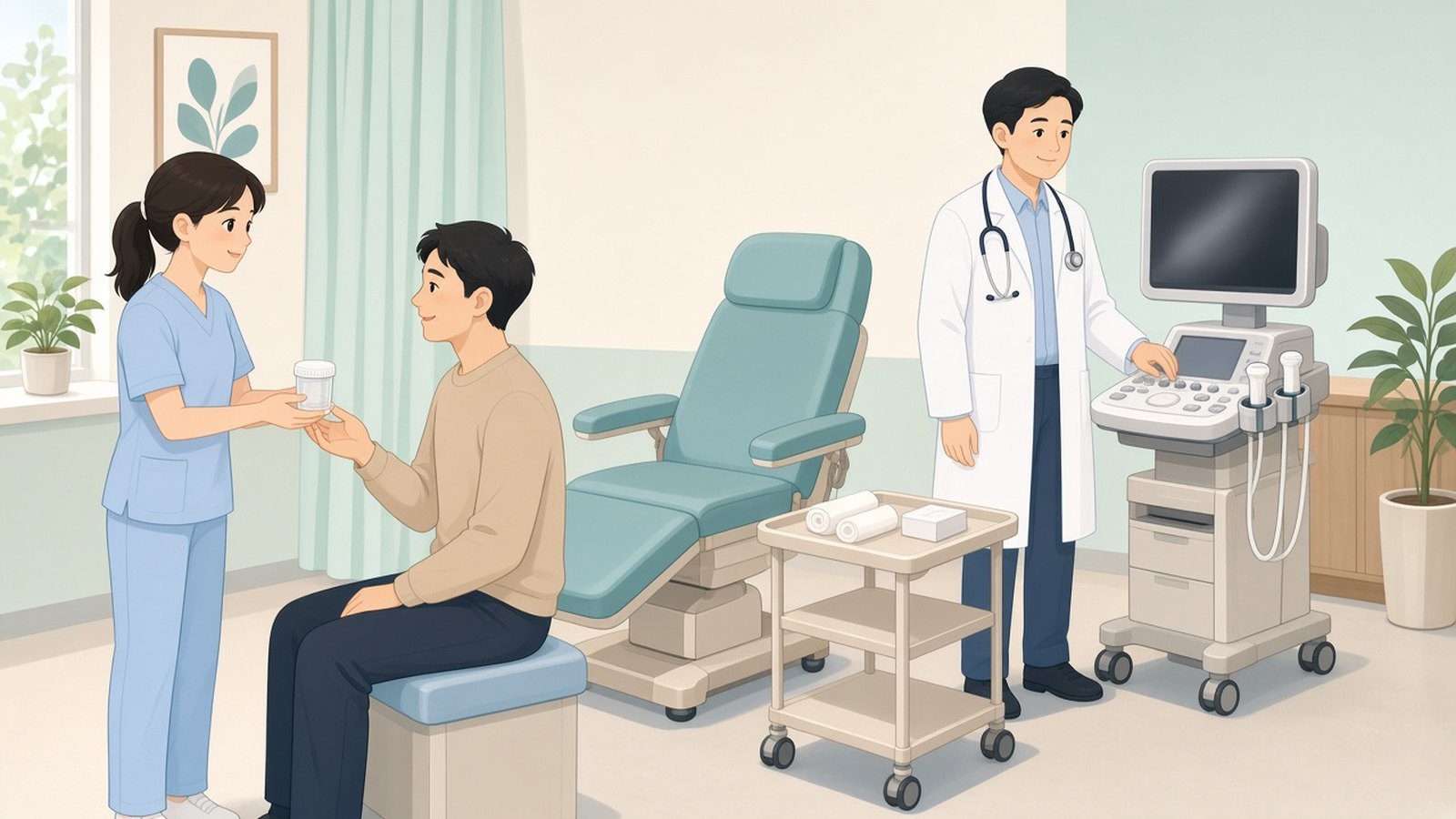
Tests for hematospermia usually move from simple to more advanced. The aim is to locate the source of bleeding and rule out conditions that need early treatment, while avoiding unnecessary over-testing.
Medical history, blood pressure and physical examination
The doctor will ask how often and for how long hematospermia has occurred, whether there is blood in the urine or pain, about recent procedures, sexual activity and medicines, and whether you bleed easily or have travelled to certain regions.
The physical examination may include measuring blood pressure and examining the genitals and scrotum. For men aged 40 or over or with prostate-related symptoms, the doctor may perform a digital rectal examination to assess the prostate.
Urine, semen and blood tests
Urinalysis and urine culture help check for infection or blood in the urine; if a sexually transmitted infection is suspected, relevant screening is arranged as appropriate. Some men may need a semen test or semen culture.
Blood tests can assess blood counts and clotting function. For men aged 40 or over, whether to test PSA may be discussed after the doctor explains what the test means and its limitations.
Imaging and endoscopy
If hematospermia recurs or you are in a higher-risk group, the doctor may arrange a urinary tract ultrasound or transrectal ultrasound to look at the prostate, seminal vesicles and ejaculatory ducts; MRI may be arranged when a more detailed assessment is needed.
If there is also blood in the urine or a lesion of the urethra or bladder is suspected, cystoscopy may be discussed. This is an invasive procedure, and whether it is needed depends on individual risk.
| Test | Main purpose | Possible limitations |
|---|---|---|
| Medical history and blood pressure | Understand the bleeding pattern, recent procedures, medicines and systemic factors | Relies on a complete history; some causes still need other tests to confirm |
| Urinalysis and urine culture | Check for urinary tract infection or accompanying blood in the urine | A single result may be affected by how the sample is collected; interpreted with clinical findings |
| STI screening | Identify infections that may cause urethritis or prostate inflammation | Tests are chosen according to exposure history; some results take time |
| Blood tests (blood count, clotting, PSA) | Assess bleeding tendency and prostate-related risk | PSA may be affected by inflammation, recent ejaculation or procedures; needs interpretation by a doctor |
| Ultrasound / transrectal ultrasound | Look for stones, cysts or obstruction in the prostate, seminal vesicles and ejaculatory ducts | Small lesions may be hard to see; the transrectal test may cause brief discomfort |
| MRI | More detailed assessment of prostate and seminal vesicle structure | Takes longer; usually reserved for recurrent or persistent cases |
| Cystoscopy | Direct view of the inside of the urethra and bladder | Invasive; possible brief discomfort, bleeding or infection risk |
How is hematospermia treated? Will it go away on its own?
Hematospermia itself is a sign, so how it is managed depends on the cause that is found, not simply on “stopping the bleeding”.
For younger men with a single episode and normal test results, observation is usually the main approach, and most improve gradually within days to weeks. During this time, watch for changes in colour and any new symptoms.
If tests show a urinary tract infection or a sexually transmitted infection, the doctor will use antibiotics based on the assessment, and the partner may also need testing and treatment. Temporary hematospermia after a prostate biopsy or vasectomy usually needs only observation and scheduled follow-up.
For stones, cysts, ejaculatory duct obstruction or dilated blood vessels in the prostate or seminal vesicles, the doctor may discuss medicines or endoscopic procedures as appropriate; systemic factors such as abnormal blood pressure or clotting need to be managed together with the relevant specialties.
Each option has its own suitable patients, limitations and risks, and individual situations differ, so decide after discussing with your doctor.
When should you seek care promptly for blood in semen?
Most hematospermia can be evaluated at a regular clinic appointment, but seek care promptly if you have:
Fever, chills, or marked perineal or lower-abdominal pain, which may indicate an acute prostate or epididymal infection.
Difficulty urinating, being unable to pass urine, or obvious blood clots in the urine.
Sudden swelling and pain of the scrotum or testicles, or hematospermia after a blow to the perineum.
Easy bleeding or bruising elsewhere in the body, or increased bleeding while taking anticoagulant medicines.

Before your visit, note the dates and number of episodes, colour changes, any pain or blood in the urine, recent tests or surgery, and the medicines you take; this helps the doctor understand your situation more quickly.
Seeing a doctor once is still advised. A single episode in a younger man is usually benign, but a doctor still needs to check for infection, blood pressure problems or other causes that need treatment; men aged 40 or over or with other symptoms are even more strongly advised to complete an evaluation.
Hematospermia itself usually does not harm a partner. But if the cause may be a sexually transmitted or urinary tract infection, use condoms or pause sexual activity until testing and treatment are complete, and have your partner assessed as your doctor advises.
Temporary hematospermia after these procedures is not uncommon and may last for several weeks or several ejaculations before gradually fading. Return earlier if there is fever, difficulty urinating, marked pain or the blood does not clear.
Hematospermia itself usually does not directly cause erectile dysfunction, but associated pain or anxiety can affect your sex life. If you are trying to conceive or have fertility concerns, tell your doctor so they can assess whether further semen tests are needed.
Some cases may be related to ejaculation after long abstinence or more vigorous sexual activity, and this is usually temporary. But it is not advisable to explain it away like this, especially if it recurs or you are in a higher-risk group; seeing a doctor is still recommended.
A urologist is the recommended first step; the doctor will assess the prostate, seminal vesicles and urinary tract. If tests point to systemic factors such as blood pressure or clotting, you may be referred to or co-managed with other specialties.
Medical references
- European Association of Urology (EAU): EAU Guidelines on Sexual and Reproductive Health — Disorders of Ejaculation (6.8 Haemospermia)
- NHS: Blood in semen
- MedlinePlus (U.S. National Library of Medicine): Blood in the semen
- Mathers MJ, Degener S, Sperling H, Roth S. Hematospermia—a Symptom With Many Possible Causes. Deutsches Ärzteblatt International (2017)
- Kumar P, Kapoor S, Nargund V. Haematospermia – A Systematic Review. Annals of The Royal College of Surgeons of England (2006)
Advice from a urologist
- If you see blood in your semen, don’t panic: most cases are linked to inflammation, infection or a recent procedure. Still, see a doctor once to check whether there is a cause that needs treatment.
- Men aged 40 or over, those with recurrent or persistent hematospermia, blood in the urine or urinary symptoms, or a family history of prostate cancer are advised to complete a more thorough evaluation.
- If you take anticoagulant medicines, do not stop them on your own; tell your doctor so they can be assessed together.
- Seek prompt care if you have fever, difficulty urinating, obvious clots or sudden swelling and pain of the scrotum.
Hematospermia is often worrying, but most causes are benign and manageable. The key is to arrange suitable tests for your age, symptoms and risk, find the likely source of bleeding and then decide on treatment or observation with follow-up. If you notice blood in your semen, have a urologist assess you in person.