

MICROSURGERY
Minimally Invasive Urological Surgery for Men
Many procedures on the foreskin, scrotum, groin and vas deferens can be done as outpatient surgery under local anesthesia. We first confirm whether surgery is really needed, then explain the method, risks and recovery for your situation — each patient is personally evaluated and operated on by Dr. Hsieh.
Procedures
Which procedure would you like to learn about?
Every procedure has situations where it is and is not suitable. Start with the common evaluation points; whether you actually need surgery must still be determined by the doctor's examination at the clinic.
Circumcision
For pathological phimosis, recurrent balanoposthitis or a previous paraphimosis, microsurgical circumcision may be evaluated.
Learn about circumcision → "A dull ache in the scrotum, feels like a bag of worms"Varicocele
May be related to scrotal discomfort or semen quality. The need for surgery is evaluated based on symptoms, tests and fertility plans.
Learn about varicocele → "A bulge in the groin"Hernia Repair
A bulge that appears when standing or straining and disappears when lying down needs to be confirmed as a hernia, and a suitable repair method chosen.
Learn about hernia repair → "My scrotum keeps getting bigger"Hydrocele
Fluid in the scrotum can cause swelling or inconvenience. Other causes are ruled out first before removal is discussed.
Learn about hydrocele surgery → "We've finished having children"Vasectomy
Understand in advance whether the no-scalpel microsurgical method suits you, how post-procedure contraception is confirmed, and the limits of reversal.
Learn about vasectomy → "I'm worried surgery will hurt"Local Anesthesia
How local anesthesia is commonly used in male genitourinary surgery, what you may feel during the procedure, and precautions.
Learn about local anesthesia →Surgical process
Every step explained clearly, from evaluation to follow-up
Understanding the process and aftercare before surgery helps you plan work and daily life, and can ease unnecessary worry.
-
Clinic evaluation
History and physical examination to confirm whether surgery is needed.
- Ultrasound or blood tests arranged if needed
-
Pre-operative explanation
The surgical method, anesthesia, risks and alternatives are explained.
- Review of medications (e.g. anticoagulants)
- Scheduling the surgery date
-
Day of surgery
Performed under local anesthesia or another method as evaluated.
- Rest and observation before going home
-
Aftercare and follow-up
Dressing changes and follow-up visits as instructed to monitor the wound and recovery.
When to get evaluated
Consider a clinic visit if you notice these
Not every problem needs surgery, but the following are worth having a doctor take a look:
- Repeated redness, swelling or cracking of the foreskin, or it cannot be retracted for cleaning
- A dull ache or pain in the scrotum, or an unusual lump
- A lump in the groin that bulges out
- You have finished having children and are considering vasectomy for contraception

Why microsurgery
A clearer view
for more precise handling
A microscope or loupes help identify blood vessels, nerves and fine tissue.
Many procedures can be done in the clinic under local anesthesia, as decided after evaluation.
Incision and suturing are planned according to the site and your individual condition.
Recovery time and how you feel after surgery differ by procedure type and individual.
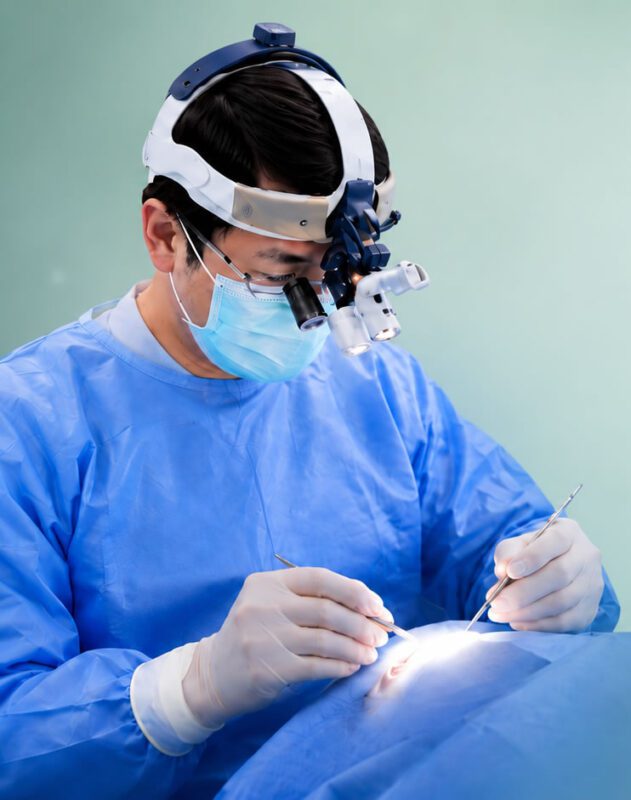
Attending physician
Dr. Cheng-Hsing Hsieh
Former Chief of Surgery and Chief of Urology, Taipei Tzu Chi Hospital
Has performed microsurgical circumcision, subinguinal microsurgical varicocelectomy, hernia repair and no-scalpel vasectomy for many years, personally overseeing each case from evaluation and surgery to follow-up.
FAQ
Common questions before surgery
Have another question? Feel free to ask about appointments on LINE.
Do I need to stay in hospital?
Many minimally invasive urological procedures for men are done as outpatient surgery, and you go home after observation. Actual arrangements depend on the procedure type, anesthesia and your health.
Does local anesthesia hurt?
There is a brief sting when the anesthetic is injected; once it takes effect, most people mainly feel pulling or pressure. Everyone feels it differently, and you can tell the doctor at any time during the procedure.
When can I return to work or exercise?
It depends on the procedure and your type of work. Desk work usually resumes sooner, while strenuous exercise, heavy lifting and sexual activity should wait until the wound heals, as advised by the doctor.
What if I take anticoagulants or medication for chronic conditions?
Please tell the doctor about all your medications. Whether any need adjusting must be assessed by the doctor together with your prescribing physician — do not stop them on your own.
Can fertility be restored after a vasectomy?
A vasectomy should be regarded as long-term contraception. Microsurgical reversal exists, but its success depends on many factors, so consider carefully before deciding.
This page provides health education and does not replace a medical diagnosis. Surgical methods, risks and recovery vary from person to person and require a personal evaluation by a doctor.