
Many middle-aged and older men notice that initiating urination takes longer, the urinary stream becomes noticeably weaker, or nighttime trips to the bathroom disrupt restful sleep. These lower urinary tract symptoms are commonly linked to benign prostatic hyperplasia (BPH).
Key points: Prostatic enlargement naturally progresses with aging and dihydrotestosterone (DHT) stimulation. Compressing the prostatic urethra results in weak stream, hesitancy, urgency, and nocturia. Evaluation involves the International Prostate Symptom Score (IPSS), uroflowmetry, post-void residual (PVR) ultrasound, and PSA testing. Treatments range from lifestyle adjustments and oral medications (alpha-blockers and 5-ARIs) to endoscopic and laser procedures evaluated by a urologist.
What is benign prostatic hyperplasia and why does it cause urinary difficulties?
The prostate is a male walnut-sized gland situated immediately below the bladder neck, encircling the upper urethra. Its primary physiological function is secreting prostatic fluid, an essential fluid component that nourishes and transports sperm.
As men age, sustained exposure to androgen metabolites—predominantly dihydrotestosterone (DHT)—causes gradual hyperplasia of the glandular tissue in the prostate transition zone, clinically designated as benign prostatic hyperplasia (BPH).
When the expanding prostate compresses the urethral lumen, bladder outflow resistance rises, producing mechanical obstruction during voiding. Over time, the bladder wall thickens and becomes hypersensitive to overcome this resistance, eventually prompting frequent urination and nocturia.
Common symptoms of BPH: voiding obstruction versus storage irritation
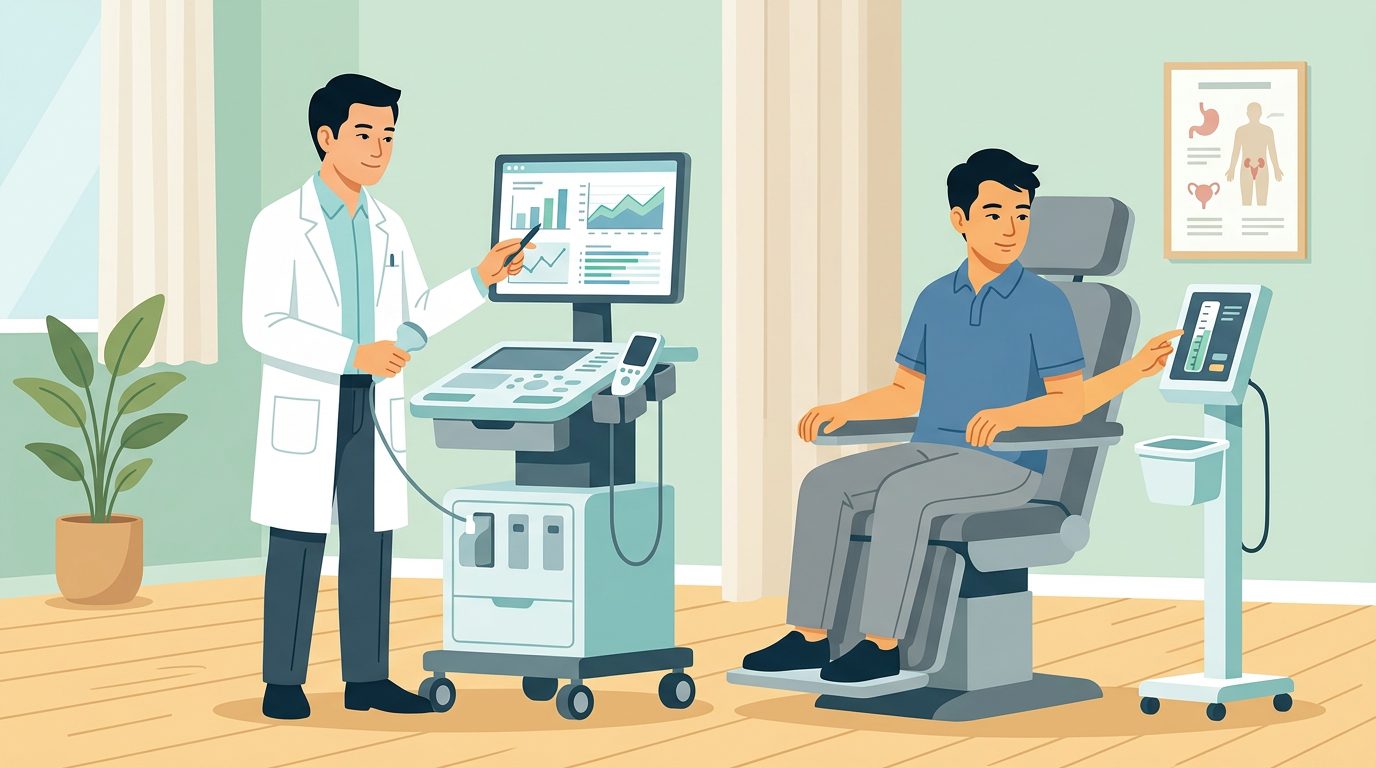
Lower urinary tract symptoms (LUTS) associated with BPH are broadly divided into obstructive voiding symptoms and irritative bladder storage symptoms.
Obstructive symptoms include urinary hesitancy (waiting at the toilet before the flow starts), a weak or interrupted stream, straining abdominal muscles to void, and post-void dribbling.
Storage symptoms include daytime urinary frequency (voiding more than 8 times daily), sudden compelling urgency, and disruptive nocturia (waking multiple times per night to urinate).
If severe voiding pain or burning occurs simultaneously, evaluate for painful urination or infection; if red or tea-colored urine is present, consider causes of hematuria or concurrent calculi.
How do urologists diagnose and evaluate benign prostatic hyperplasia?
Urologists utilize standardized diagnostic assessments to evaluate prostate volume, urinary obstruction, and bladder function objectively.
The International Prostate Symptom Score (IPSS) questionnaire quantifies symptom severity from mild (0-7) to moderate (8-19) and severe (20-35). Digital rectal examination (DRE) assesses prostate size, firmness, and the absence of nodules.
Uroflowmetry measures peak flow rate (Qmax), while post-void residual (PVR) ultrasound detects remaining urine volume. Routine urinalysis and serum PSA testing help screen for infections and rule out suspected malignancy.
Serum PSA testing assists in differentiating benign enlargement from suspected prostate cancer, while ultrasound also checks for concurrent urinary stones or hydronephrosis.
Comparing BPH treatments: lifestyle, medications, and minimally invasive surgery

Management depends on symptom severity, urinary obstruction, and the presence of secondary complications.
Initial medical therapy includes alpha-1 adrenergic antagonists to relax prostatic smooth muscle and improve flow quickly, as well as 5-alpha reductase inhibitors (5-ARIs) to halt gland growth and reduce prostate volume over several months.
When medication yields inadequate relief or complications occur—such as recurrent urinary retention, bladder calculi, refractory gross hematuria, or renal impairment—surgical intervention is indicated.
Options include transurethral resection of the prostate (TURP), bipolar enucleation, advanced laser vaporization/enucleation, and minimally invasive implants that preserve sexual and ejaculatory function based on patient eligibility.
| Treatment Modality | Target Indication & Characteristics | Clinical Considerations |
|---|---|---|
| Lifestyle & Watchful Waiting | Mild symptoms (IPSS 0-7), minimal residual urine | Evening fluid moderation, regular follow-up |
| Alpha-1 Blockers | Moderate obstructive symptoms needing rapid relief | Relaxes smooth muscle quickly; watch for dizziness |
| 5-ARIs (e.g., Finasteride) | Significantly enlarged prostate volume (>30-40 ml) | Reduces gland volume; requires several months of therapy |
| Laser Prostate Enucleation/Vaporization | Moderate-to-severe BPH, refractory to medications | Excellent hemostasis, rapid recovery, endoscopic route |
| Minimally Invasive Implants | Patients seeking preservation of ejaculatory function | Assessed individually based on prostate anatomy and size |
Daily lifestyle habits, bladder care, and preventing acute urinary retention
Healthy daily routines play a crucial role in reducing prostatic congestion and protecting bladder reserve.
Maintain balanced daytime hydration, but limit fluids within two hours of bedtime to reduce nocturia awakenings. Avoid delaying urination or holding urine for prolonged periods, which can overstretch the detrusor muscle.
Limit excessive alcohol and caffeine intake, as both can cause acute prostatic engorgement. Exercise caution with over-the-counter cold, allergy, or cough medicines containing antihistamines or decongestants, which can inadvertently trigger acute urinary retention.
No. Benign prostatic hyperplasia (BPH) is a benign cellular proliferation occurring primarily in the transition zone of the prostate, whereas prostate cancer predominantly arises in the peripheral zone. While they are distinct pathologies, both conditions can coexist in the same individual, making routine urological screening essential.
Not at all. The vast majority of men with mild-to-moderate symptoms achieve satisfying symptom control through lifestyle modifications and oral medications. Surgery is reserved for patients with severe refractory symptoms, recurrent acute urinary retention, bladder stones, or impaired kidney function.
Many over-the-counter cold, flu, and allergy preparations contain first-generation antihistamines or pseudoephedrine. These agents relax the bladder detrusor muscle while tightening the prostate sphincter, which can precipitate complete inability to void in men with pre-existing BPH.
Modern transurethral and laser procedures rarely injure the erectile cavernous nerves running outside the prostate capsule, meaning erectile function is generally preserved. However, widening the bladder neck can lead to retrograde ejaculation (ejaculatory fluid entering the bladder harmlessly). Discuss specific sexual priorities with your surgeon prior to treatment.
Urgent medical attention is necessary if you experience acute urinary retention (painful, full bladder with inability to void), visible blood clots in urine, high fever accompanied by chills and flank discomfort, or bilateral leg swelling with markedly reduced urine output.
Authoritative Medical References
- National Institute of Diabetes and Digestive and Kidney Diseases (NIH / NIDDK): Benign Prostatic Hyperplasia
- National Health Service (NHS): Benign Prostate Enlargement Overview & Management
- American Urological Association (AUA): Management of BPH Clinical Guidelines
- European Association of Urology (EAU): Male Lower Urinary Tract Symptoms (LUTS) Guidelines
Urologist’s Advice
- Men over 50 experiencing diminished stream or multiple nocturnal awakenings should undergo uroflowmetry and ultrasound post-void residual evaluation early.
- Medical therapy provides reliable symptom management for the vast majority of patients when tailored to prostate size and bladder symptoms.
- Avoid prolonged sitting, excessive alcohol consumption, and habituated urinary holding to safeguard bladder wall compliance.
- Consult a urologist promptly if voiding symptoms impair sleep or if acute urinary retention occurs.
Prostate enlargement is a common progressive physiological change in aging men. The primary goal of modern management is safeguarding renal and bladder health while restoring daily voiding comfort. Treatment should always be individualized through personal consultation with a qualified urologist.