Morley JE, Charlton E, Patrick P, Kaiser FE, Cadeau P, McCready D, et al. Validation of a screening questionnaire for androgen deficiency in aging males. Metabolism. 2000;49:1239–1242.
Goldstein I, Lue TF, Padma-Nathan H, Rosen RC, Steers WD, Wicker PA. Oral sildenafil in the treatment of erectile dysfunction. Sildenafil Study Group. N Engl J Med. 1998 May 14;338(20):1397-404.
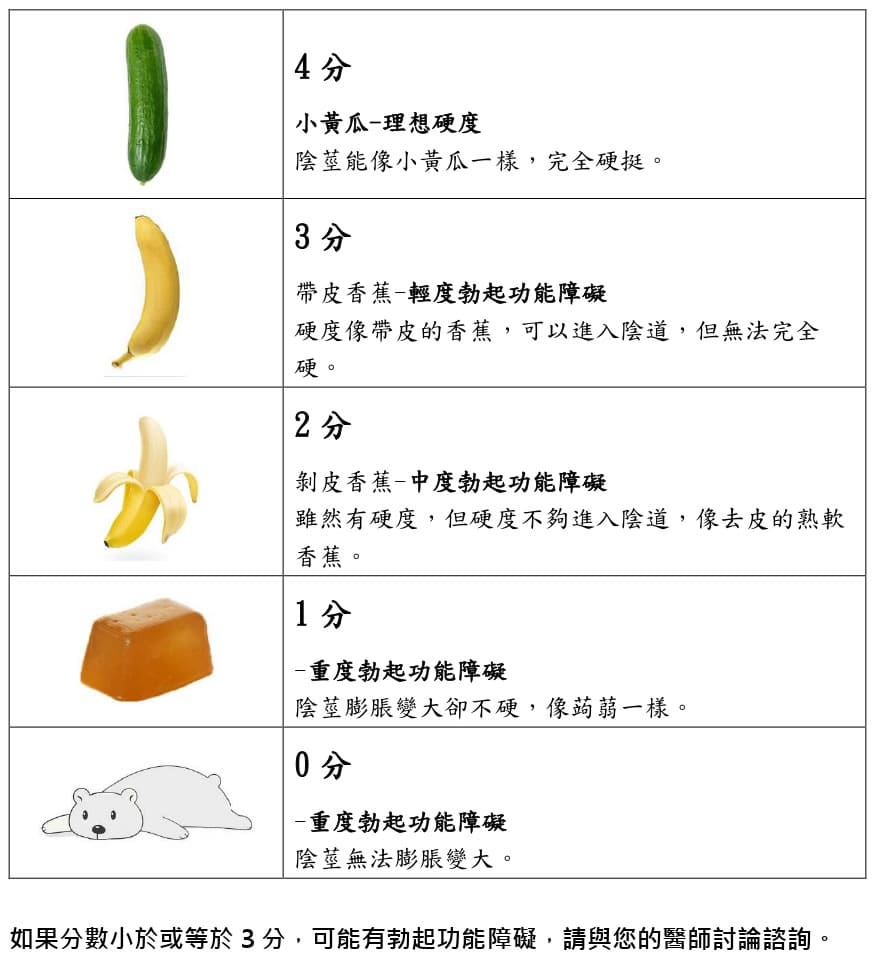
註1: 此份評估表為男性性健康調查量表 (The Sexual Health Inventory for Men, SHIM),乃源於國際勃起功能指標量表 (the abridged 5-item version of the International Index of Erectile Function, IIEF-5) ,評估表標題沿用”國際勃起功能指標量表”僅為方便評估辨識。
Birowo P, Rangganata E, Rasyid N, Atmoko W. Efficacy and safety of extracorporeal shockwave therapy for the treatment of chronic non-bacterial prostatitis: A systematic review and meta-analysis. PLoS One. 2020;15(12):e0244295.
Fojecki GL, Tiessen S, Osther PJS. Extracorporeal shock wave therapy (ESWT) in urology: A systematic review of outcome in Peyronie’s disease, erectile dysfunction and chronic pelvic pain. World J Urol. 2017;35(1):1–9.
Engeler D, Baranowski AP, Berghmans B, et al. EAU guidelines on chronic pelvic pain. Arnhem, The Netherlands: European Association of Urology; 2023.
Zimmermann R, Cumpanas A, Miclea F, Janetschek G. Extracorporeal shock wave therapy for the treatment of chronic pelvic pain syndrome in males: A randomized, double-blind, placebo-controlled study. Eur Urol. 2009;56(3):418–24.
Moayednia A, Bonyadi M, Jahanfar S, et al. The effect of low-intensity extracorporeal shock wave therapy on chronic pelvic pain syndrome: A randomized, single-blind, placebo-controlled trial. Int Urol Nephrol. 2014;46(11):2133–9.
Vahdatpour B, Alizadeh F, Moghaddam SS. Evaluation of extracorporeal shock wave therapy for treatment of chronic pelvic pain syndrome: A randomized placebo-controlled trial. Urol J. 2013;10(2):886–90.
Zengin K, Tanik S, Sener NC, et al. Effectiveness of low-intensity extracorporeal shockwave therapy in patients with chronic pelvic pain syndrome refractory to 3-As therapy. Prostate Cancer Prostatic Dis. 2017;20(1):84–9.
Russo GI, Basile G, Condorelli RA, et al. Efficacy of low-intensity extracorporeal shock wave therapy for the treatment of chronic pelvic pain syndrome: Systematic review and meta-analysis. Urology. 2018;117:12–9.
Wang Y, Liu Y, Li J, et al. Low-intensity extracorporeal shockwave therapy for chronic prostatitis/chronic pelvic pain syndrome: A systematic review and meta-analysis. Int J Impot Res. 2020;32(4):403–14.
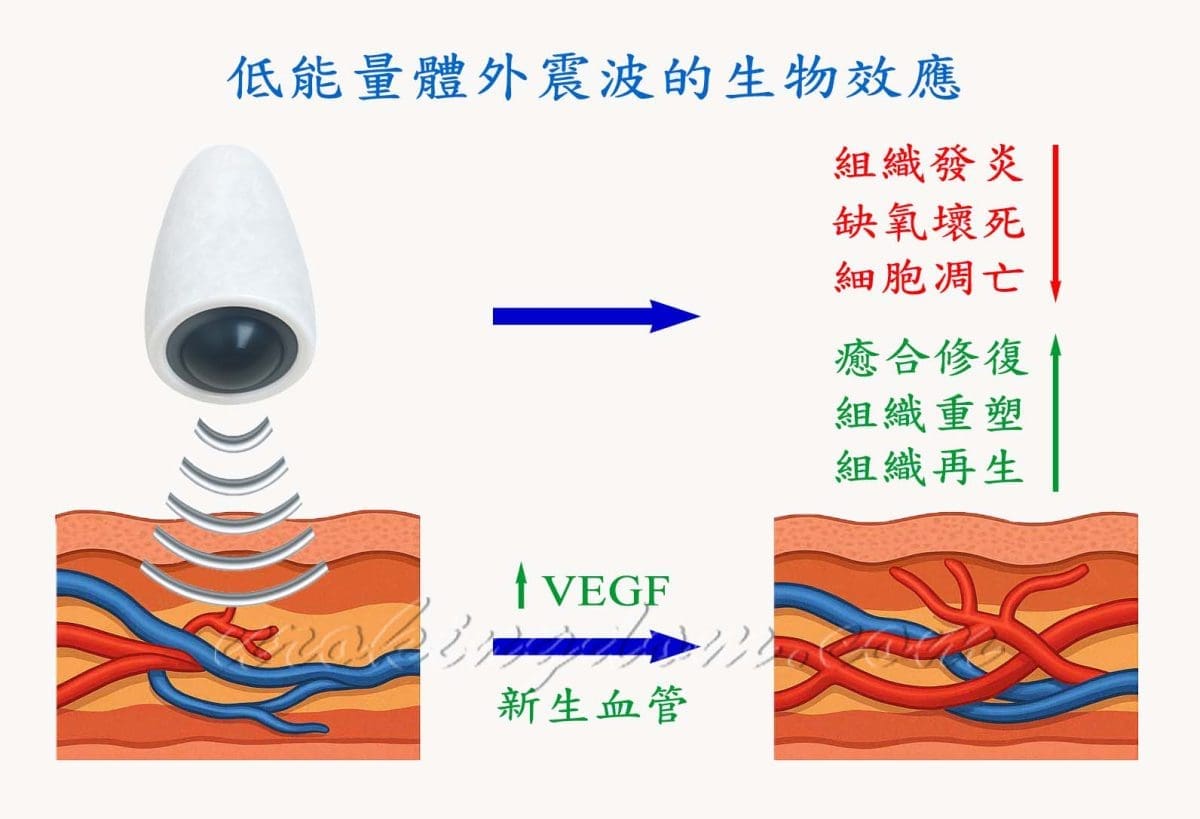
Mykoniatis I, Pyrgidis N, Sokolakis I, Hatzichristodoulou G. Low-intensity shockwave therapy in urological diseases: Clinical applications and mechanisms of action. World J Urol. 2022;40(6):1453–62.
• 改善勃起功能:臨床上常以國際勃起功能指數問卷(International Index of Erectile Function (IIEF) Questionnaire)評估勃起功能與治療效果。多項研究顯示,低能量體外震波治療能顯著提高國際勃起功能指數的分數,特別是對於血管性勃起功能障礙具有顯著改善效果;對於神經性或心理性勃起功能障礙效果較有限。
Fode M, Hatzichristodoulou G, Serefoglu EC, et al. Low-intensity shockwave therapy for erectile dysfunction: is the evidence strong enough? Nat Rev Urol. 2017;14(10):593–606.
Lu Z, Lin G, Reed-Maldonado A, et al. Low-intensity extracorporeal shock wave treatment improves erectile function: a systematic review and meta-analysis. Eur Urol. 2017;71(2):223–33.
Rizk PJ, Krieger JR, Kohn TP, et al. Low-intensity shockwave therapy for erectile dysfunction. Sex Med Rev. 2018;6(4):624–30.
Sokolakis I, Dimitriadis F, Teo P, et al. The basic science behind low-intensity extracorporeal shockwave therapy for erectile dysfunction: a systematic scoping review of pre-clinical studies. J Sex Med. 2019;16(2):168–94.
Lu Z, Lin G, Reed-Maldonado A, Wang C, Lee YC, Lue TF. Low-intensity extracorporeal shock wave treatment improves erectile function: a systematic review and meta-analysis. Eur Urol. 2017;71(2):223–33.
Clavijo RI, Kohn TP, Kohn JR, Ramasamy R. Effects of low-intensity extracorporeal shockwave therapy on erectile dysfunction: a systematic review and meta-analysis. J Sex Med. 2017;14(1):27–35.
Man L, Li G. Low-intensity extracorporeal shock wave therapy for erectile dysfunction: a systematic review and meta-analysis. Urology. 2018;119:97–103.
Dong L, Chang D, Zhang X, Li J, Yang F. Effect of low-intensity extracorporeal shock wave therapy on patients with erectile dysfunction: a systematic review and meta-analysis. Am J Mens Health. 2019;13(6):1–11.
Yao F, Li S, Lin H, Chen L, Yang D. Efficacy of low-intensity extracorporeal shock wave therapy for erectile dysfunction: a systematic review and meta-analysis of randomized controlled trials. Am J Mens Health. 2022;16(2):1–13.
Wei X, Li Y, Zhao Y, Wu T, Huang Y. Network meta-analysis of low-intensity shock wave therapy parameters for vasculogenic erectile dysfunction. Front Pharmacol. 2024;15:1208699.
摘要: Circumcision is one of the oldest surgical procedures in the world. Despite its history, the medical benefits and risks of circumcision remain controversial. Although neonatal circumcision reduces the development and recurrence rates of urinary tract infection (UTI) in children, routine circumcision is only recommended in children with high risk of UTI. Further large-scale studies are required to prove if topical steroid hormones are an alternative therapy to circumcision in the prevention of pediatric UTI. In men, it is well-established that circumcision can reduce the risks of transmitting sexually transmitted diseases (STDs), including human immunodeficiency virus (HIV), human papilloma virus, type 2 herpes simplex virus, and syphilis. The World Health Organization and the United Nations Program on HIV/AIDS has recommended promotion of circumcision in areas with a high prevalence of heterosexually transmitted HIV. Since circumcision only partially prevents STD, opponents worry that risk compensation (not using a condom and increased sexual partners) may overwhelmingly reduce the protective effects of circumcision. Parents and patients need to weigh the benefits and risks of male circumcision to make well-informed decisions about this procedure.